
Updated Information
Categories
Popular
How to Buy Real Estate in Japan as a Foreigner: A Complete Step-by-Step Guide
Property Knowledge
【Updated data in 2025】Japan’s Land Prices Continue to Surge, with Tokyo’s 23 Wards Leading the Growth
Market Information

Essential Knowledge for Property Investment in Japan (Part 1): Understanding Japan’s Earthquake Resistance Standards
Property Knowledge
Tokyo Rents Surge to 30-Year High: Why This Rising Trend Signals a Prime Investment Opportunity in the Property Market?
Market Information
Exploring Koenji: A Harmonious Blend of City Convenience and Creative Culture
Exploring Tokyo
Why Kamata area is the Next Hotspot for Property Investment in Tokyo?
Exploring Tokyo
【2026 Updated Data】Japan Land Prices Continue Rising, Driven by Tokyo’s 23 Wards
Land prices in Japan continued to rise in 2026, reflecting sustained growth across both residential and commercial markets. Tokyo’s 23 wards remained the primary driver of this expansion, supported by strong demand and ongoing redevelopment activity. The following section outlines key national trends, regional performance, and investment implications, with a focus on Tokyo and surrounding areas.
■ Introduction
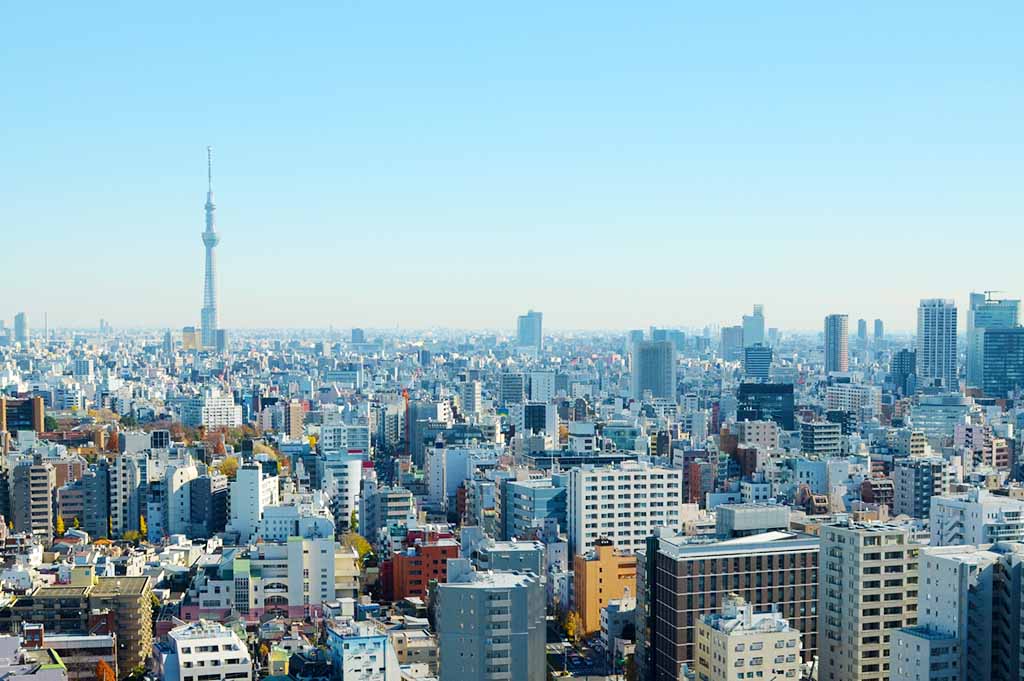
Land prices across Japan continued to increase in 2026, indicating a sustained growth phase in the overall real estate market. According to the latest official land price data released by Japan’s Ministry of Land, Infrastructure, Transport and Tourism, both residential and commercial land values rose nationwide, with Tokyo’s 23 wards recording the strongest overall performance.
The 2026 data show continued appreciation compared to previous years, with relatively stronger growth observed in selected urban areas. This trend is supported by stable demand, ongoing redevelopment activity, and the gradual normalization of economic conditions.
This article provides an overview of national and regional land price trends, outlines the main factors influencing price movements, and reviews related investment conditions, with a focus on Tokyo and surrounding regions.
■ National and Regional Land Price Trends in Japan
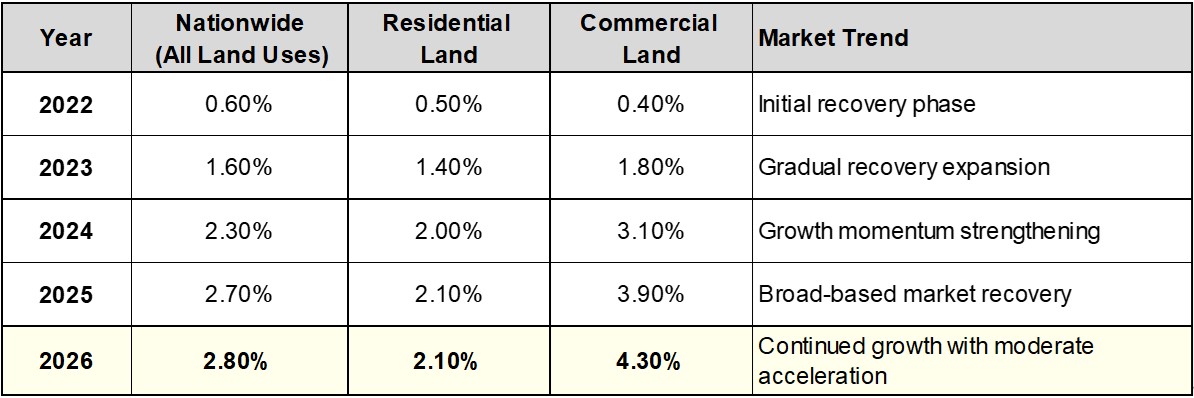
In March 2026, the Japanese government announced the official land prices as of January 1, 2026, revealing that nationwide land prices rose by 2.8% year-on-year. Residential land increased by 2.1%, while commercial land saw a stronger rise of 4.3%, marking the fifth consecutive year of overall growth. This level of increase represents one of the strongest growth rates in recent decades and signals a clear shift from post-pandemic recovery toward sustained expansion.
● Japan Land Price Trend (2022–2026)
■ Land Price Trends Across Major Japanese Cities in 2026
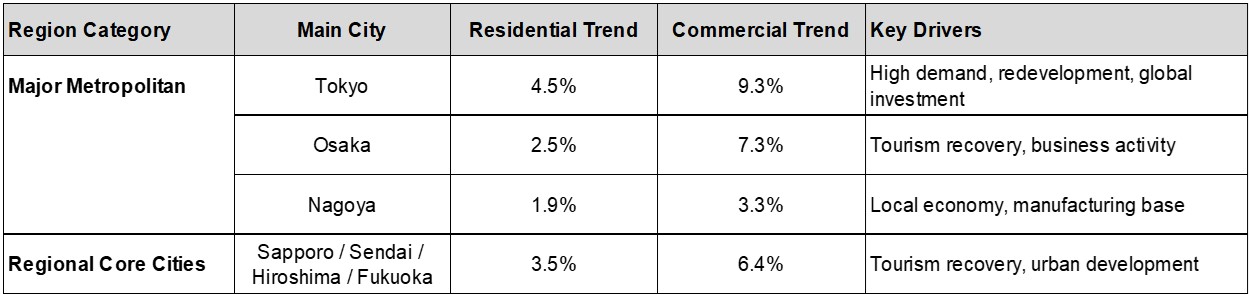
Within Japan’s three major metropolitan cities including Tokyo, Osaka, and Nagoya, land prices continued to rise steadily in 2026, with Tokyo once again outperforming the national average, recording approximately +4.5% growth in residential land and over +9.3% in commercial land. Osaka also maintained solid momentum, with residential land increasing by around +2.5% and commercial land by +7.3%, supported by the recovery of tourism and business activity.
Meanwhile, Nagoya recorded more moderate but stable increases, with residential growth at approximately +1.9% and commercial land rising by +3.3%, reflecting steady local demand. At the same time, regional cities such as Sapporo, Sendai, Hiroshima, and Fukuoka experienced continued growth, approximately+4.5% in overall land value, driven by tourism recovery, infrastructure improvements, and localized economic development.
● Land Price Trend in Main Cities (2026)
■ Key Trends in Land Prices and the Driving Forces Behind Them
The continued rise in land prices across Japan reflects a combination of structural and economic factors influencing both residential and commercial markets. These factors vary across regions and asset types but collectively support the overall upward trend observed in 2026.
Key Driving Factors:
- Sustained Urban Residential Demand
Demand remains strong in major cities such as Tokyo and Osaka, supported by population concentration, lifestyle convenience, and a low-interest-rate environment, contributing to steady residential price growth. - Strong Performance in Central Tokyo
Prime residential areas in central Tokyo have recorded growth exceeding +10%, driven by limited land supply and consistent demand from both domestic and overseas buyers. - Expansion to Outer and Suburban Areas
As central prices rise, demand has shifted toward more affordable outer wards and suburban locations, where land prices have increased at a moderate pace of approximately +3% to +6%. - Recovery in Commercial Demand
Nationwide commercial land prices rose by +4.3%, while Tokyo recorded stronger growth of around +9.3%, reflecting increased demand for office, retail, and hospitality properties. - Tourism Recovery Impact
The return of inbound tourism has boosted commercial activity in key districts such as Shibuya and Asakusa, supporting land price growth in these areas. - Redevelopment and Infrastructure Projects
Large-scale redevelopment in areas such as Shibuya Ward, Nakano Ward, and Shinagawa ward has driven significant increases in land values, with some locations recording high growth in land value.
Looking ahead, these factors are expected to continue supporting land price growth, particularly in major metropolitan areas and redevelopment zones. While regional differences remain, the overall market outlook suggests a stable and sustained upward trend in strategically important locations across Japan.
■ Overview of Tokyo’s 23 Wards Real Estate Growth
Tokyo’s 23 wards continue to demonstrate strong and stable expansion in 2026, supported by both residential demand and commercial redevelopment momentum. Growth remains uneven but broadly distributed, with clear leadership from central wards and rising activity in emerging redevelopment zones.
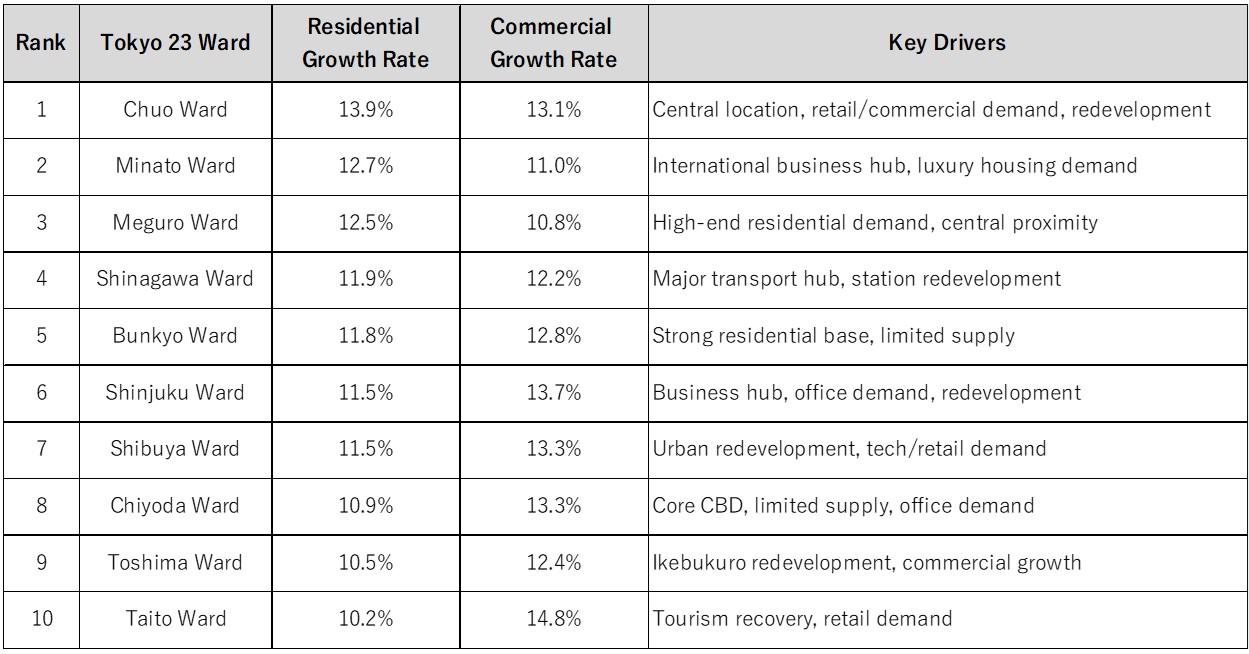
The top-performing wards in Tokyo’s 23 wards in 2026 are predominantly located in central and inner-core areas, where both residential land prices and commercial land prices recorded strong double-digit growth. Chuo Ward ranked highest, with residential land prices increasing by 13.9 percent and commercial land prices by 13.1 percent, followed by Minato Ward, where residential land prices rose by 12.7 percent and commercial land prices by 11.0 percent, and Meguro Ward, with increases of 12.5 percent and 10.8 percent respectively. Major business districts such as Shinjuku, Shibuya, and Chiyoda also demonstrated robust performance, supported by strong office demand, ongoing redevelopment, and limited land supply. These trends indicate that central Tokyo continues to drive overall market growth, with both residential and commercial segments showing consistent upward movement.
At the same time, several wards outside the traditional core also recorded notable growth, reflecting a broader distribution of market momentum. Shinagawa and Bunkyo showed balanced growth across both residential and commercial sectors, while Toshima and Taito benefited from redevelopment and tourism-related demand. In particular, Taito recorded the highest increase in commercial land prices among the top 10 wards, highlighting continued recovery in retail and hospitality sectors. Overall, the data suggests that growth in 2026 is supported by a combination of redevelopment activity, infrastructure improvements, and diversified demand across both residential and commercial markets.
● Top 10 Growth Wards in Tokyo’s 23 Wards (2026)
■ Expansion of Demand Beyond Central Tokyo
One of the most notable trends in 2026 is the expansion of real estate demand beyond central Tokyo into outer wards and surrounding areas. As property prices in central locations continue to rise, both homebuyers and investors are increasingly exploring alternative areas that offer more affordable entry points while still providing convenient access to the city center.
This shift is driven by several factors, including the rising cost of housing in central Tokyo, improvements in transportation infrastructure, and changing lifestyle preferences that prioritize space and cost efficiency. Outer Tokyo areas have benefited from this trend, with land prices increasing steadily at rates of approximately 3% to 6%, reflecting growing demand and improving market confidence.
■ The Rising Appeal of Outer Tokyo Areas in Real Estate Investment
The data from 2026 clearly indicates a structural shift in Japan’s real estate market, where demand is no longer concentrated solely in central Tokyo but is expanding across the broader metropolitan area. Neighboring regions such as Saitama Prefecture, Chiba Prefecture, and Kanagawa Prefecture are increasingly benefiting from this trend, offering more affordable investment opportunities while still being closely connected to Tokyo.
These areas provide investors with the potential to achieve better yields due to lower entry prices, while also benefiting from stable rental markets supported by ongoing population inflow. As infrastructure continues to improve and connectivity with central Tokyo strengthens, the long-term growth potential of these areas is expected to increase further.
■ Conclusion: Japan’s Real Estate Market Enters a New Growth Phase
The 2026 official land price data indicates that Japan’s real estate market continues to show a sustained upward trend, supported by both residential and commercial demand. Nationwide land prices continue to rise steadily, with Tokyo remaining the primary driver of overall market expansion.
Within Tokyo, growth is led by central wards, while selected outer wards and redevelopment areas are also showing increasing momentum. This reflects a more distributed growth structure compared to previous cycles, with performance differences driven by location, accessibility, and redevelopment activity.
From an investment perspective, opportunities are no longer limited to core central districts. A wider range of locations across Tokyo and selected regional cities are demonstrating stable fundamentals and potential for medium- to long-term value growth. As market conditions remain generally supportive, Japan, particularly Tokyo, continues to present a stable and active real estate investment environment.
~ END ~
※Source: All the above tables and graphics are generated from the data of the Ministry of Land, Infrastructure, Transport and Tourism, Japan.
If you would like to learn more about investment properties in Japan, please click here. >
・Recommended Articles
Exploring Tokyo2022.4.25
Basic Information of Tokyo Area
Tokyo is one of the metropolitan cities in the world. As a capital city of Japan, the city tops the population […]

Property Knowledge2026.7.15
What are the costs incurred when buying a property in Japan?
First published on 2022.4.28 Purchasing property in Japan involves more than just the agreed purchase price. B […]
Property Knowledge2025.6.6
How to Buy Real Estate in Japan as a Foreigner: A Complete Step-by-Step Guide
Posted on 2022.9.22 > Updated on 2025.6.6 Basically, the procedure for buying real estate in Japan is more […]
Property Knowledge2024.5.17
Essential Knowledge for Overseas Investors in Japanese Property Management
Real estate management is a specialized discipline involving multiple complex processes and different areas of […]
Subscribe for Latest Property News
Don’t miss out! Subscribe now to stay tuned to the latest trends, news, and listings in Japan’s real estate market.


