
Updated Information
Categories
Popular
How to Buy Real Estate in Japan as a Foreigner: A Complete Step-by-Step Guide
Property Knowledge

【Updated data in 2025】Japan’s Land Prices Continue to Surge, with Tokyo’s 23 Wards Leading the Growth
Market Information
Essential Knowledge for Property Investment in Japan (Part 1): Understanding Japan’s Earthquake Resistance Standards
Property Knowledge

Tokyo Rents Surge to 30-Year High: Why This Rising Trend Signals a Prime Investment Opportunity in the Property Market?
Market Information
Exploring Koenji: A Harmonious Blend of City Convenience and Creative Culture
Exploring Tokyo
Why Kamata area is the Next Hotspot for Property Investment in Tokyo?
Exploring Tokyo
What is the meaning of 1R, 1K, 1DK and 1LDK in Japan property?
First published on 2022.5.23
Understanding Japanese apartment floor plans is essential when buying or investing in property in Japan. Residential properties are commonly classified using abbreviations such as 1R, 1K, 1DK, and 1LDK, which describe the number of rooms and the property’s layout.
This article also serves as a Japan property floor plan guide, explaining these common Japanese real estate abbreviations through sample floor plans and photographs to help readers understand the different types of residential layouts in Japan.
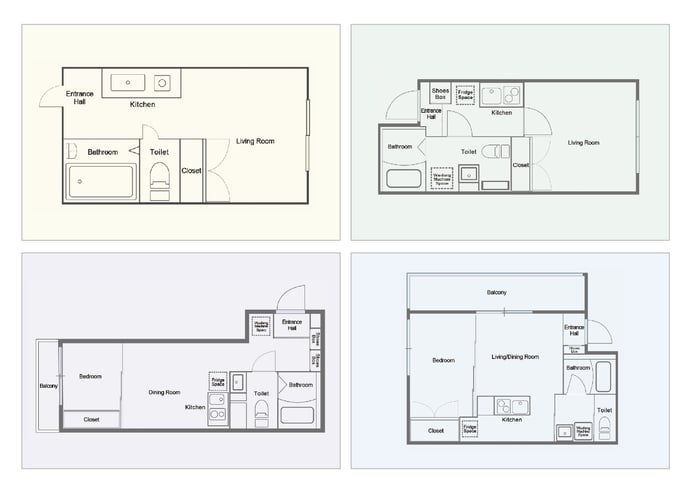
■ Understanding Japanese Property Floor Plans
If you are planning to buy a home or invest in real estate in Japan, understanding Japanese apartment floor plans is an essential first step. This Japan property floor plan guide explains how residential properties are categorized and what the common floor plan abbreviations mean. Whether you are looking for a condominium or a detached house, Japanese real estate agents will typically ask about your preferred floor plan before recommending suitable properties.
In Japan, floor plans are commonly identified using abbreviations such as 1R, 1K, 1DK, 1LDK, and 2LDK. These standard classifications describe both the number of rooms and the overall layout of a property. Understanding these Japanese apartment floor plans will make it easier to compare property listings, communicate your requirements to real estate agents, and select a home or investment property that best suits your needs.
If you are new to the Japanese property market, these abbreviations may appear confusing at first. Fortunately, they are easy to understand. Most Japanese real estate abbreviations are simply combinations of the initial letters of common English words that describe a property’s room configuration and living spaces. Once you know what each letter stands for, reading Japanese property listings becomes simple and intuitive.
R – Room
K- Kitchen
L – Living
D – Dining
Once the meaning of each letter is understood, interpreting Japanese apartment floor plans becomes much easier. For example, 2LDK refers to a property with two bedrooms, together with a living room, dining area, and kitchen. While this layout is relatively straightforward, the differences between 1R, 1K, 1DK, and 1LDK are often less obvious. Although these Japanese real estate abbreviations all describe compact residential layouts, they differ in the size, configuration, and separation of the living, dining, and kitchen spaces. Understanding these distinctions makes it easier to compare Japanese property listings and select a floor plan that best suits different living or investment needs.
■ 1R vs. 1K: What’s the Difference?
Most people are easy to get confused for the floorplan types 1R and 1K.
1R – One room?
1K – One kitchen?
At first glance, the term 1K may seem confusing, as it literally suggests “one room with a kitchen.” The distinction between 1R and 1K is much easier to understand by referring to the following floor plans.
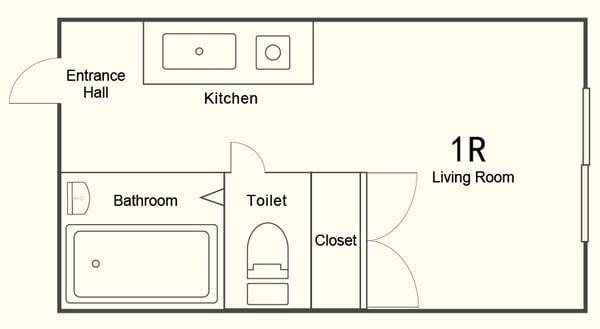
The floor plan above illustrates a typical 1R (One Room) apartment. This compact studio layout consists of a single open living space, with only the bathroom and toilet separated into individual rooms. The kitchen is positioned near the entrance and opens directly into the main living area, creating an open-plan layout. As a result, the entire apartment is visible from the entrance, offering less privacy than layouts with a separate kitchen. Most 1R apartments in Japan have a floor area of approximately 16–22 m², making them a popular choice for single occupants and investors seeking compact rental properties.
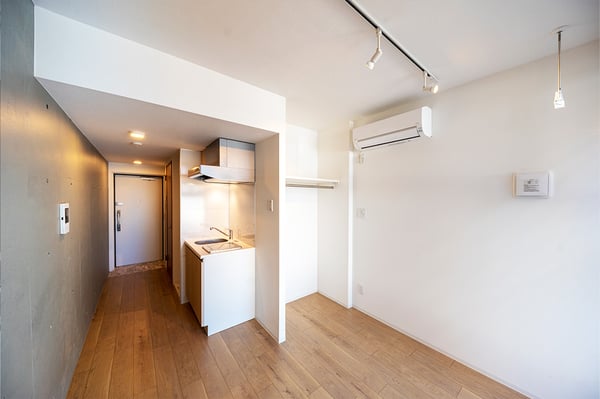
The photograph below shows a 1R apartment at COCOCUBE KAWASAKI, located in Kawasaki City, Kanagawa Prefecture.
The second picture below is the floorplan of 1K flat.
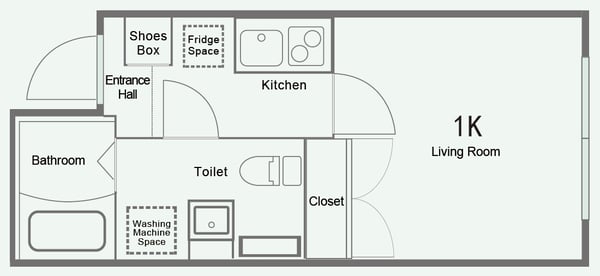
Compared with a 1R apartment, the most noticeable feature of a 1K layout is the door separating the kitchen from the main living area. This partition prevents the entire room from being visible from the entrance, providing greater privacy. It also helps contain cooking odors within the kitchen, making it easier to maintain a cleaner and more comfortable living space. Typical 1K apartments in Japan have a floor area of approximately 18–28 m², offering slightly more space and functionality than a standard 1R layout.
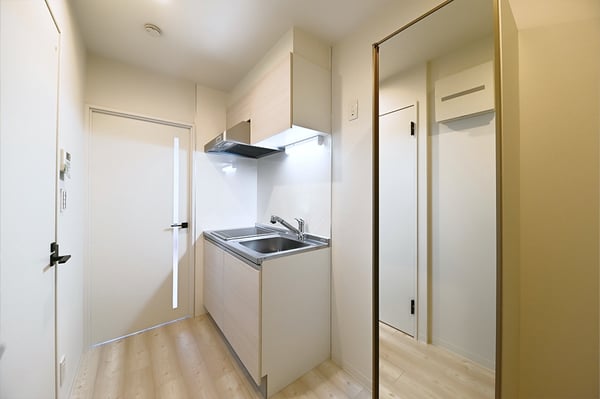
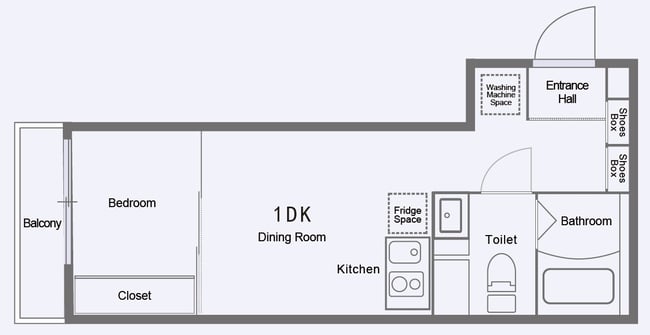
In general, the key difference between 1R and 1K apartments lies in the separation of the kitchen from the main living area. A 1R apartment features a single open-plan space, making the room feel more spacious despite its smaller floor area. In contrast, a 1K apartment has a separate kitchen, providing greater privacy and helping to keep cooking odors away from the living space, resulting in a more comfortable living environment. Although 1R apartments generally have lower monthly rents than 1K apartments, rental prices ultimately depend on factors such as location, building age, property condition, and available amenities.
■ 1DK vs. 1LDK: What’s the Difference?
After understanding the difference between 1R and 1K, the next step is to distinguish between 1DK and 1LDK. At first glance, the missing “L” in 1DK may suggest that there is no living room. In fact, the difference lies in the size and function of the shared living space rather than the presence or absence of a living room. The following floor plans illustrate the distinction between these two Japanese apartment floor plans.
The floor plan above shows a typical 1DK (One Bedroom + Dining Kitchen) apartment. It consists of one separate bedroom and a combined dining and kitchen area. Unlike a 1LDK, the DK space is relatively compact and is primarily intended for dining and meal preparation rather than as a full living area. In Japan, a DK is generally smaller than an LDK, which is why the letter “L” (Living Room) is omitted. The dining kitchen area in a typical 1DK apartment is approximately 7.3–12.96 m². Most 1DK apartments also include a built-in closet, with the bathroom and toilet provided as separate rooms.
The next picture shows the floorplan of 1LDK.
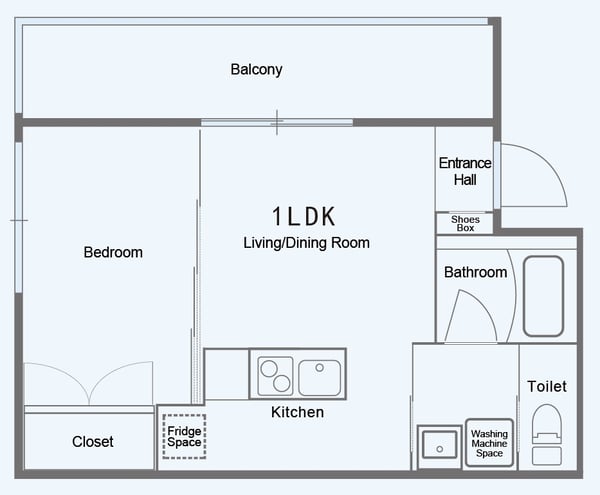
The floor plan above illustrates a typical 1LDK (One Bedroom + Living, Dining and Kitchen) apartment. It features one separate bedroom with a built-in closet, a separate bathroom and toilet, a designated space for a washing machine, and an LDK area that combines the living room, dining area, and kitchen. Unlike a 1DK, the living space is larger and designed to comfortably accommodate everyday activities such as relaxing, dining, and entertaining guests.
In general, a property is classified as a 1LDK when the living, dining, and kitchen (LDK) area is separate from the bedroom and provides sufficient space to function as a living room in addition to a dining area and kitchen. As a result, 1LDK apartments are typically larger than 1DK apartments and generally command higher monthly rents, although rental prices ultimately vary depending on factors such as location, building age, and property condition.
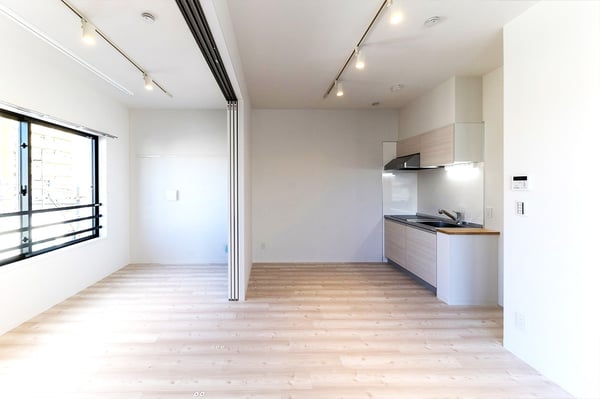
1LDK of COCOCUBE Kita-shinagawa
Apart from the space of bedroom, living/dining, toilet and bathroom, and so forth, there is also balcony space on the floorplans of 1DK and 1LDK. Balcony is very common for rooms in Japan even for the room types of 1R or 1K. One might not know that the floor area of a room always excludes the space of balcony. The reason behind will be discussed later in another article.
To conclude, although the difference between the above 4 types of rooms is not that distinct, each of them still can fulfill the needs of different people. For example, as the monthly rental of 1R and 1K is comparative lower, their demand by single people is quite high, especially in big cities like Tokyo and Osaka. While for those of 1DK and 1LDK which are more spacious and comfortable, they are favored by those people with more budget and even couples without kids. If one is considering to make a long-term investment in properties, it is suggested to invest those properties with 1R or 1K as there is always higher demand on that. Properties like the residential brand “COCOCUBE” which is an en-bloc residential building with rooms of 1R or 1K are recommended as all rooms in the building are well-equipped with simplified original design and located in convenient place near stations.
■ Summary
To conclude, Overall, each of these Japanese apartment floor plans is designed to suit different lifestyles and budgets. 1R and 1K apartments generally offer lower monthly rents, making them particularly popular among single occupants, especially in major cities such as Tokyo and Osaka. In contrast, 1DK and 1LDK apartments provide larger and more comfortable living spaces, making them well suited to professionals, couples, and residents seeking greater comfort.
From an investment perspective, 1R and 1K properties often enjoy stable rental demand due to their affordability and broad appeal among single tenants. For investors seeking compact residential assets, COCOCUBE is a notable example of a modern apartment brand offering well-designed 1R and 1K units in convenient locations close to railway stations, making it an attractive option in Japan’s rental market.
>>Looking to invest in Japanese real estate? Click here to discover more investment opportunities.
・Recommended Articles
Property Knowledge2026.7.15
What are the costs incurred when buying a property in Japan?
First published on 2022.4.28 Purchasing property in Japan involves more than just the agreed purchase price. B […]
Property Knowledge2025.6.6
How to Buy Real Estate in Japan as a Foreigner: A Complete Step-by-Step Guide
Posted on 2022.9.22 > Updated on 2025.6.6 Basically, the procedure for buying real estate in Japan is more […]
Property Knowledge2022.4.2
Why Reinforced Concrete (RC) Residential Building is good for long-term investment?
Buildings of reinforced concrete offer several advantages including long life and less maintenance, this is es […]
Exploring Tokyo2022.4.25
Basic Information of Tokyo Area
Tokyo is one of the metropolitan cities in the world. As a capital city of Japan, the city tops the population […]
Subscribe for Latest Property News
Don’t miss out! Subscribe now to stay tuned to the latest trends, news, and listings in Japan’s real estate market.


